What it does
This Playwright MCP test generator is a supporting QA automation helper that converts a product URL, user story, acceptance criteria, and safe auth notes into browser automation drafts for refinement in Claude Code, Cursor, or another MCP client.
Common use cases
- Generate Playwright automation from a Jira story
- Turn acceptance criteria into browser test steps
- Create Claude Code and Cursor prompts for Playwright MCP sessions
- Draft MCP config snippets without real secrets
- Compare browser automation coverage with MCP server testing
- Pair manual QA coverage with automation-ready Gherkin scenarios
How to use it
- Enter the feature URL or local route
- Paste the user story, acceptance criteria, and auth notes
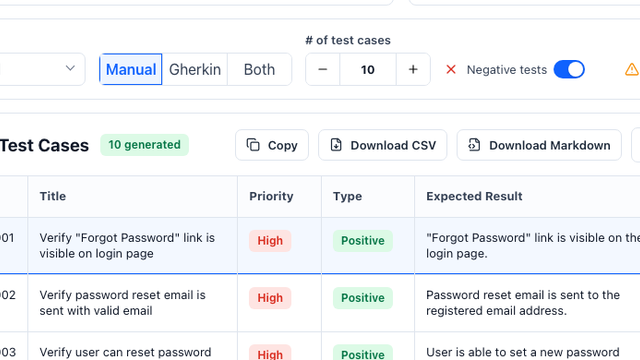
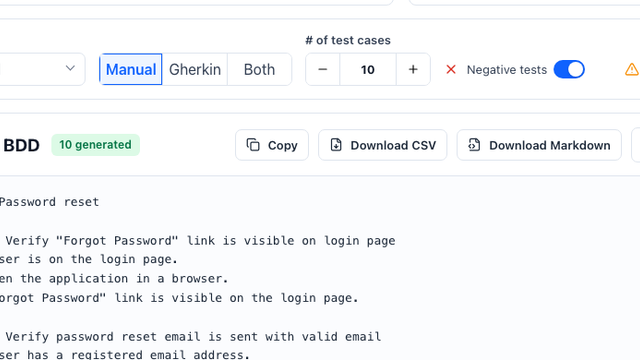
- Generate Playwright outline, code skeleton, MCP config, prompts, Gherkin, and manual cases
- Copy or download the artifacts, then refine selectors against the live app
- Use the MCP server testing checklist if your automation depends on a custom MCP server
Best inputs
Use clear requirements, acceptance criteria, validation rules, user roles, constraints, and examples of valid or invalid data.
What should I provide to generate useful Playwright MCP tests?
Use a real URL or route, the user story, acceptance criteria, user roles, safe test data notes, auth fixture notes, and any selectors or stable labels your app already exposes.
Can Claude Code run the generated Playwright MCP prompt directly?
The prompt is designed as a strong Claude Code starting point. Review selectors, auth setup, environment URLs, and project test conventions before committing generated tests.
Can I use the generated prompt in Cursor?
Yes. The tool generates a Cursor-oriented prompt that asks Cursor to use Playwright MCP, inspect the target URL, draft a spec skeleton, and list selectors or fixtures that need review.
Is this an official Playwright tool?
No. This is an unofficial QA helper for drafting Playwright MCP prompts, configs, and test artifacts. It is not affiliated with or endorsed by Microsoft, Playwright, Cursor, or Anthropic.
Should I paste real credentials or API keys into the auth notes?
No. Use placeholders, seeded QA accounts, storage-state fixtures, or mocked auth helpers. Do not paste real passwords, API keys, session cookies, production tokens, or private account data.
How is Playwright MCP testing different from MCP server testing?
Playwright MCP testing checks browser workflows and generated Playwright automation. MCP server testing checks whether a custom MCP server starts, exposes correct schemas, handles auth, rejects bad inputs, and is understood by agents.
Can I export generated test cases to Jira, Xray, Zephyr, or TestRail?
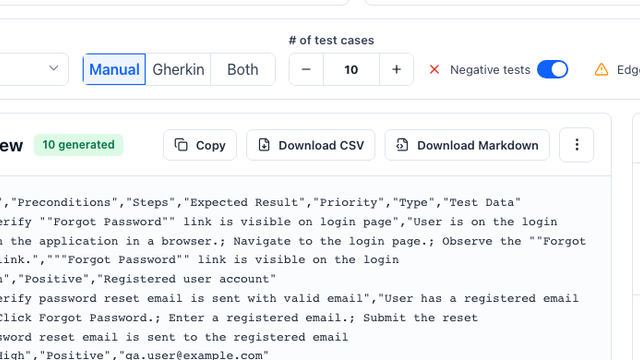
Yes. The generator can structure cases as a CSV-ready table with title, preconditions, steps, expected result, priority, type, and test data fields.
Does the tool replace QA review?
No. It accelerates first-draft coverage, but QA teams should review edge cases, business rules, and product-specific risks before importing cases.
What inputs produce the best test cases?
A clear user story, acceptance criteria, business rules, constraints, and examples of valid or invalid test data produce the strongest output.