AITestCaseGenerator
Free

AI Generator

AI Test Case Generator

Generate manual test cases, Gherkin, edge cases, and CSV exports.

Open generator

QA knowledge base

AI Test Case Generator: guide, workflow, and examples

What it does

An AI test case generator converts requirements, user stories, and acceptance criteria into structured QA coverage that can be reviewed, edited, and imported into test management tools.

Common use cases

  • Create a first QA pass before sprint planning
  • Generate test cases from requirements
  • Convert user stories to test cases
  • Turn acceptance criteria into QA cases
  • Expand positive flows with negative and edge coverage
  • Standardize test case fields before Jira or TestRail import
  • Create Playwright automation prompts after manual review

How to use it

  1. Enter the requirement, PRD excerpt, or user story
  2. Add acceptance criteria, roles, validation rules, constraints, and examples of valid or invalid data
  3. Generate positive, negative, boundary, and error-handling test cases
  4. Review priorities, steps, expected results, test data, and traceability
  5. Export CSV, Gherkin, Jira-ready fields, or automation notes

Best inputs

Use clear requirements, acceptance criteria, validation rules, user roles, constraints, and examples of valid or invalid data.

Example generated QA coverage
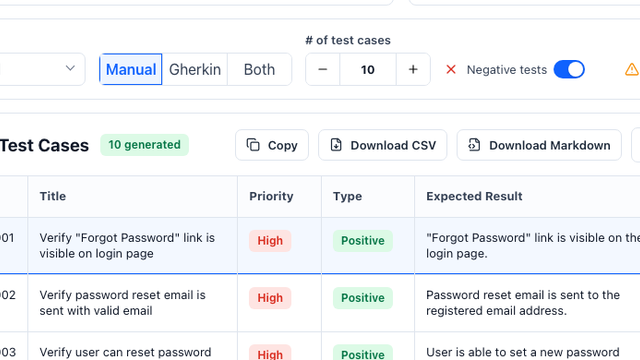
IDTitlePriorityTypeExpected Result
TC-001Verify password reset request with a registered emailHighPositiveA reset link is sent and the user receives a confirmation message.
TC-002Verify weak password is rejected during resetHighNegativeThe form blocks submission and explains the password rule that failed.
TC-003Verify expired reset link cannot be usedMediumEdge CaseThe link is rejected and the user can request a fresh reset email.
Can an AI test case generator create test cases from requirements?

Yes. Paste a requirement, PRD excerpt, user story, or acceptance criteria and the generator drafts manual test cases, negative cases, boundary cases, error-handling cases, Gherkin, CSV fields, and automation-oriented prompts.

How do I use AI to generate test cases from requirements?

Provide structured inputs, including the requirement, acceptance criteria, user roles, constraints, validation rules, and examples. Generate positive, negative, boundary, and error-handling coverage, then review the result before import.

Can I convert acceptance criteria to test cases?

Yes. Acceptance criteria can be mapped to positive, negative, and edge cases, with each criterion checked against at least one expected result.

Can I generate automation from the same input?

Use this page for manual and Gherkin coverage, then open the Playwright MCP generator to create Playwright steps, spec drafts, and Claude Code or Cursor prompts.

Can I export generated test cases to Jira, Xray, Zephyr, or TestRail?

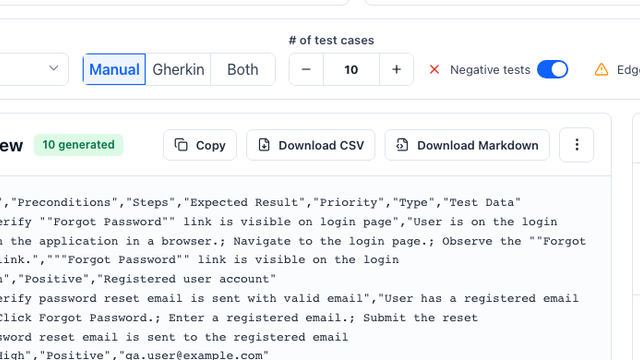
Yes. The generator can structure cases as a CSV-ready table with title, preconditions, steps, expected result, priority, type, and test data fields.

Does the tool replace QA review?

No. It accelerates first-draft coverage, but QA teams should review edge cases, business rules, and product-specific risks before importing cases.

What inputs produce the best test cases?

A clear user story, acceptance criteria, business rules, constraints, and examples of valid or invalid test data produce the strongest output.
Direct answer

To generate test cases using AI from requirements, paste the requirement, add acceptance criteria and constraints, ask for positive, negative, boundary, and error-handling coverage, then review the AI output before exporting CSV, Gherkin, Jira-ready fields, or automation prompts.

How to generate test cases using AI from requirements

Start with structured inputs: requirement text, actor, goal, business rules, acceptance criteria, permissions, limits, and sample data. Ask the generator to map each rule to at least one test case and to call out assumptions that need human review.

Human review before import

AI-generated test cases are a strong first draft. A QA lead should verify business-rule accuracy, remove duplicate cases, add product-specific risks, and confirm every acceptance criterion has observable expected results.

Coverage matrix

Positive, negative, boundary, and error-handling coverage

Coverage typeWhat to testExample
PositiveThe main path that proves the requirement works for an eligible user with valid data.Registered user requests a password reset and receives a valid reset email.
NegativeInvalid input, wrong state, blocked permission, or unsupported user action.User submits a weak password and sees the specific rule that failed.
BoundaryLimits, time windows, minimum and maximum values, and near-expiry states.Reset link works at 29 minutes but is rejected after the 30-minute expiry.
Error handlingRecoverable failures, retries, unavailable services, and safe messages.Email service fails and the UI shows a retryable message without leaking account status.

Output examples

Output examples

CSV output example

TC-001, Verify password reset with registered email, High, Positive, Steps: request reset and open link, Expected: reset email is sent and the reset page opens.

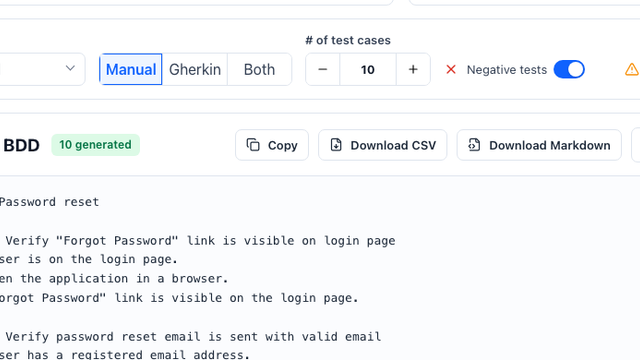
Gherkin output example

Given a registered user, when they request a password reset, then the system sends a valid reset link and shows a confirmation.

Jira output example

Summary: Verify expired reset link is blocked. Priority: High. Labels: qa, password-reset. Expected Result: user can request a fresh link.

Related tool

From AI test cases to automation and MCP validation

After generating manual QA cases, use the Playwright MCP generator for browser automation or the Test MCP Server checklist when your QA workflow depends on MCP tools.

Open Test MCP Server checklist

Read more

QA workflow guides

View all guides
Test Case Generator screenshot

Test Case Generator

Generate manual QA test cases, software test cases, requirements-based cases, and user-story test cases with examples and templates.

QA templates - 6 min read
Acceptance Criteria Generator screenshot

Acceptance Criteria Generator

Use the acceptance criteria generator to turn feature notes into testable rules, QA checks, and Given/When/Then examples before sprint handoff.

Acceptance criteria - 5 min read
User Story to Manual Test Cases screenshot

User Story to Manual Test Cases

See how a password reset story becomes reviewable QA cases with priorities, types, and expected results.

Guide - 6 min read
Generate Gherkin BDD Scenarios screenshot

Generate Gherkin BDD Scenarios

Turn acceptance criteria into Given / When / Then scenarios for product and engineering review.

BDD - 5 min read
Jira Test Case Generator screenshot

Jira Test Case Generator

Convert Jira stories into manual test cases, Gherkin, CSV, Xray, and Zephyr-ready QA rows for sprint review and import.

Jira QA - 5 min read
AI Test Case Generator for Jira screenshot

AI Test Case Generator for Jira

Paste a Jira story, bug report, or acceptance criteria and export Classic cases, Gherkin, CSV, Excel, Xray, or Zephyr-ready fields.

Jira workflow - 5 min read
Review Cases Before Import screenshot

Review Cases Before Import

Use the review console to inspect steps, preconditions, expected results, and suggested test data.

QA workflow - 7 min read
Generate Playwright Automation screenshot

Generate Playwright Automation

Draft Playwright MCP test steps, automation cases, and Claude Code prompts from a URL and acceptance criteria.

Playwright MCP - 6 min read
Test MCP Server Checklist screenshot

Test MCP Server Checklist

Generate smoke checks, tool-call cases, malicious input probes, permission checks, and Claude Code or Cursor prompts for MCP server testing.

MCP testing - 7 min read
AI Agent Replay Debugging screenshot

AI Agent Replay Debugging

Use a replay checklist, immutable audit log fields, trace template, and comparison table to reproduce failed AI agent interactions.

Agent QA - 6 min read
CSV, Xray, and Zephyr Export Workflow screenshot

CSV, Xray, and Zephyr Export Workflow

Format generated QA cases for CSV review, Excel handoff, and Jira-connected imports.

Export workflow - 4 min read