What it does
An acceptance criteria generator turns product intent into concrete, testable rules that QA, product managers, and engineers can review before implementation.
Common use cases
- Draft acceptance criteria during backlog refinement
- Convert loose feature notes into Given/When/Then rules
- Find missing validation, permission, and error-state requirements
- Create testable examples before generating manual or Gherkin test cases
How to use it
- Paste the feature idea, user story, or PRD excerpt
- Add user roles, business rules, and known constraints
- Generate acceptance criteria with positive, negative, and edge coverage
- Review the criteria, then convert them into test cases or Gherkin scenarios
Best inputs
Use clear requirements, acceptance criteria, validation rules, user roles, constraints, and examples of valid or invalid data.
How do I write acceptance criteria with AI?
Paste the user story, product goal, role, business rules, constraints, and examples. The generator drafts Given/When/Then acceptance criteria, then you review whether each criterion is specific, observable, and testable.
What is an acceptance criteria generator?
An acceptance criteria generator turns a feature idea, user story, or PRD excerpt into clear pass/fail rules that product, QA, and engineering teams can review before implementation.
What makes good acceptance criteria?
Good acceptance criteria are specific, testable, observable, and tied to business rules. They should include success paths, validation rules, permissions, and important edge cases.
Can I turn generated acceptance criteria into test cases?
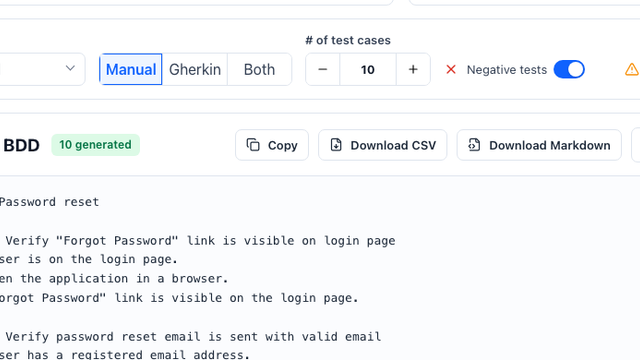
Yes. Use the generated criteria as the input for manual test cases, Gherkin scenarios, CSV exports, or Jira-friendly QA coverage. Each criterion should map to at least one expected result.
What is an acceptance criteria example?
For a team-invite feature: Given an admin enters a valid email and role, when they send the invitation, then the system creates one invite, sends the email, and shows a confirmation. Add separate criteria for duplicate members, expired links, and non-admin access.
Can acceptance criteria be converted into Jira test cases?
Yes. Map each Given/When/Then rule to a Jira-friendly case with a title, preconditions, steps, test data, expected result, priority, and type. Then review the cases before attaching them to the story or preparing a CSV for Xray or Zephyr.
Should acceptance criteria use Given/When/Then?
Given/When/Then is useful when teams want BDD-style clarity, but bullet criteria are also fine as long as each item is testable and unambiguous.
Can I export generated test cases to Jira, Xray, Zephyr, or TestRail?
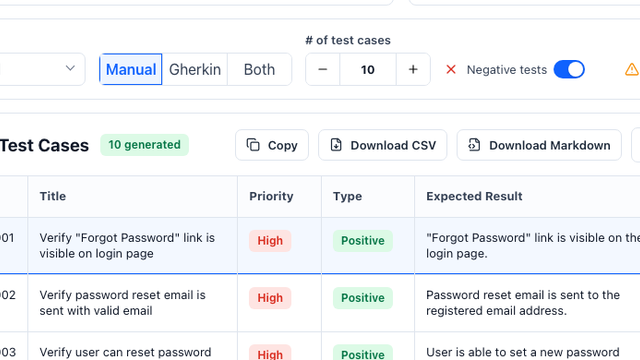
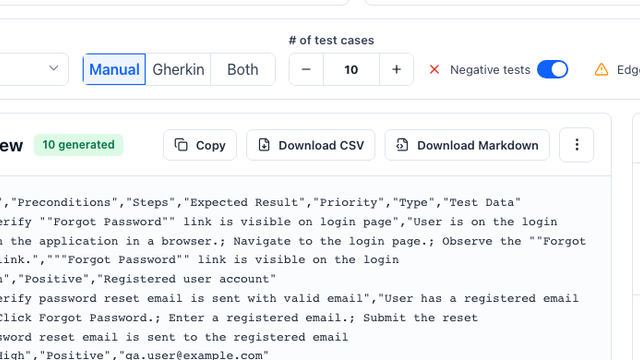
Yes. The generator can structure cases as a CSV-ready table with title, preconditions, steps, expected result, priority, type, and test data fields.
Does the tool replace QA review?
No. It accelerates first-draft coverage, but QA teams should review edge cases, business rules, and product-specific risks before importing cases.
What inputs produce the best test cases?
A clear user story, acceptance criteria, business rules, constraints, and examples of valid or invalid test data produce the strongest output.