What it does
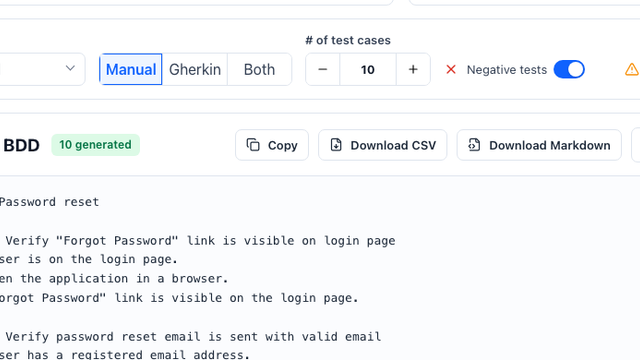
A Gherkin test case generator turns requirements into readable Given/When/Then scenarios so product, QA, and engineering teams can align on expected behavior.
Common use cases
- Draft BDD scenarios before automation
- Clarify acceptance criteria with concrete examples
- Create shared product and engineering review artifacts
- Pair manual QA coverage with executable-style scenarios
How to use it
- Paste the feature requirement
- Include rules, examples, and edge conditions
- Generate Given/When/Then scenarios
- Review wording before using scenarios in a BDD workflow
Best inputs
Use clear requirements, acceptance criteria, validation rules, user roles, constraints, and examples of valid or invalid data.
Can generated Gherkin be used directly in automation?
It should be reviewed first. The output is a strong draft, but automation teams still need matching step definitions and project-specific wording.
Can I export generated test cases to Jira, Xray, Zephyr, or TestRail?
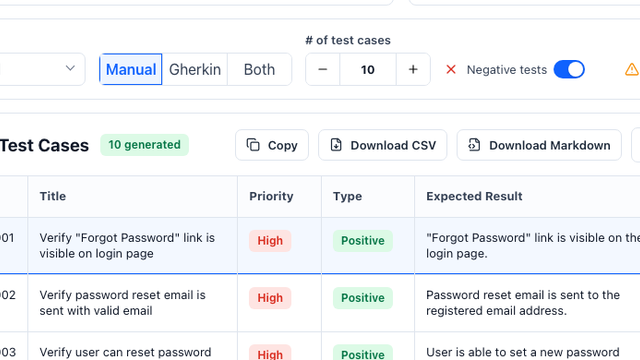
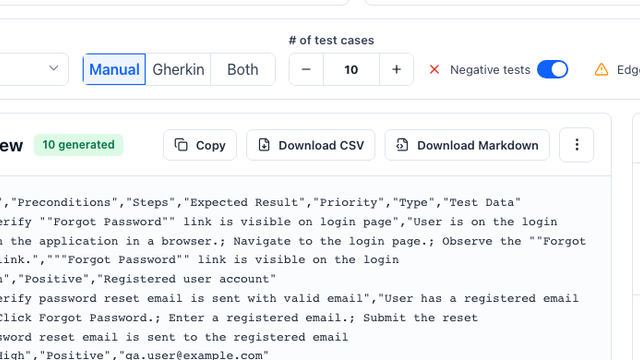
Yes. The generator can structure cases as a CSV-ready table with title, preconditions, steps, expected result, priority, type, and test data fields.
Does the tool replace QA review?
No. It accelerates first-draft coverage, but QA teams should review edge cases, business rules, and product-specific risks before importing cases.
What inputs produce the best test cases?
A clear user story, acceptance criteria, business rules, constraints, and examples of valid or invalid test data produce the strongest output.