What it does
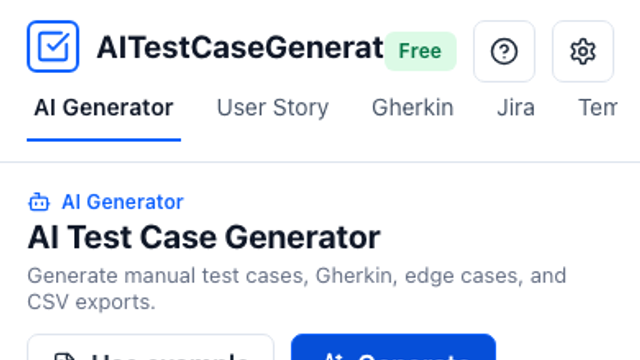
An AI test case generator converts requirements, user stories, and acceptance criteria into structured QA coverage that can be reviewed, edited, and imported into test management tools.
Common use cases
- Create a first QA pass before sprint planning
- Generate test cases from requirements
- Convert user stories to test cases
- Turn acceptance criteria into QA cases
- Expand positive flows with negative and edge coverage
- Standardize test case fields before Jira or TestRail import
- Create Playwright automation prompts after manual review
How to use it
- Enter the requirement, PRD excerpt, or user story
- Add acceptance criteria, roles, validation rules, constraints, and examples of valid or invalid data
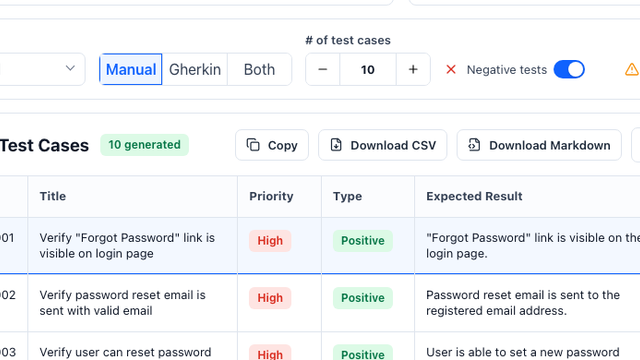
- Generate positive, negative, boundary, and error-handling test cases
- Review priorities, steps, expected results, test data, and traceability
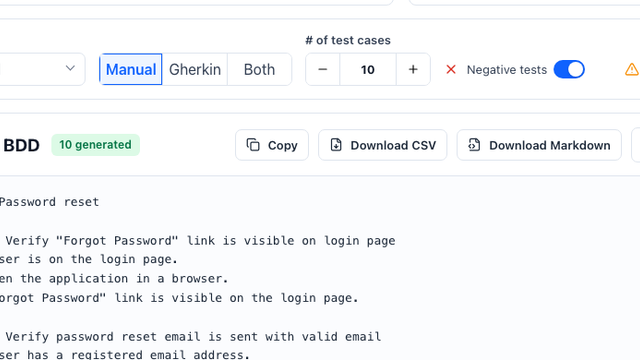
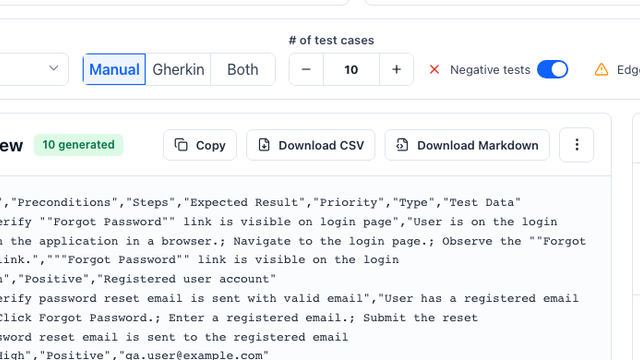
- Export CSV, Gherkin, Jira-ready fields, or automation notes
Best inputs
Use clear requirements, acceptance criteria, validation rules, user roles, constraints, and examples of valid or invalid data.
Can an AI test case generator create test cases from requirements?
Yes. Paste a requirement, PRD excerpt, user story, or acceptance criteria and the generator drafts manual test cases, negative cases, boundary cases, error-handling cases, Gherkin, CSV fields, and automation-oriented prompts.
How do I use AI to generate test cases from requirements?
Provide structured inputs, including the requirement, acceptance criteria, user roles, constraints, validation rules, and examples. Generate positive, negative, boundary, and error-handling coverage, then review the result before import.
Can I convert acceptance criteria to test cases?
Yes. Acceptance criteria can be mapped to positive, negative, and edge cases, with each criterion checked against at least one expected result.
Can I generate automation from the same input?
Use this page for manual and Gherkin coverage, then open the Playwright MCP generator to create Playwright steps, spec drafts, and Claude Code or Cursor prompts.
Can I export generated test cases to Jira, Xray, Zephyr, or TestRail?
Yes. The generator can structure cases as a CSV-ready table with title, preconditions, steps, expected result, priority, type, and test data fields.
Does the tool replace QA review?
No. It accelerates first-draft coverage, but QA teams should review edge cases, business rules, and product-specific risks before importing cases.
What inputs produce the best test cases?
A clear user story, acceptance criteria, business rules, constraints, and examples of valid or invalid test data produce the strongest output.